Showing posts with label Harvest. Show all posts

Sunday, December 13, 2015

Harvesting Ground Peanut

Yep, it's the peanut I planted last July! I finally harvested them last November, about 3 weeks ago.


From 1 big container and 1 4-gallon pot I only harvested about 500 grams of whole peanut(including the shell). In below picture, you can see some nutshell was covered with white fluffy wax, that's because the plants were attacked by mealybugs. I thought I had a late harvest because some of the peanuts have started to re-germinate. 


But ideally, it takes 4-5 months for peanut from planting to harvest. So, it shouldn't be too late to harvest them in November. I guessed some are rotten and germinated because it had been raining a lot. The other reason, or main reason, why I only harvested a little was because the plants overgrew the containers and many runners that developed the pegs, which supposed to become peanuts failed to enter the soil, thus many pegs were spoiled as the picture below.

It could be that I gave them too little space between plants. So when they overgrew, it's already too hard to fix the problem.

Peanut is quite easy to plant, it's perfect to be directly planted in the ground as it will be spacious for the runners/pegs to reach the ground. It's also VERY possible to plant it in containers. But for a better harvest, just make sure you give each plant enough space to grow. See, how much we learn from our from the process! Experience is the best Teacher!


Saturday, November 7, 2015

Third round in this year...


This is the third round of my "Harum Manis" fruit production this year. We've been enjoying the fruit this couple of months and new shoots are now ready to grow.


By this time my "Nam Dok Mai" is flowering for the third round also, and some fruits have been formed. Maybe they can be harvested around late December or early next January. I can't be more grateful! 


Harvesting Turmeric and Ginger Part 1

Turmeric Rhizomes often used as traditional medicine/herbal drinks

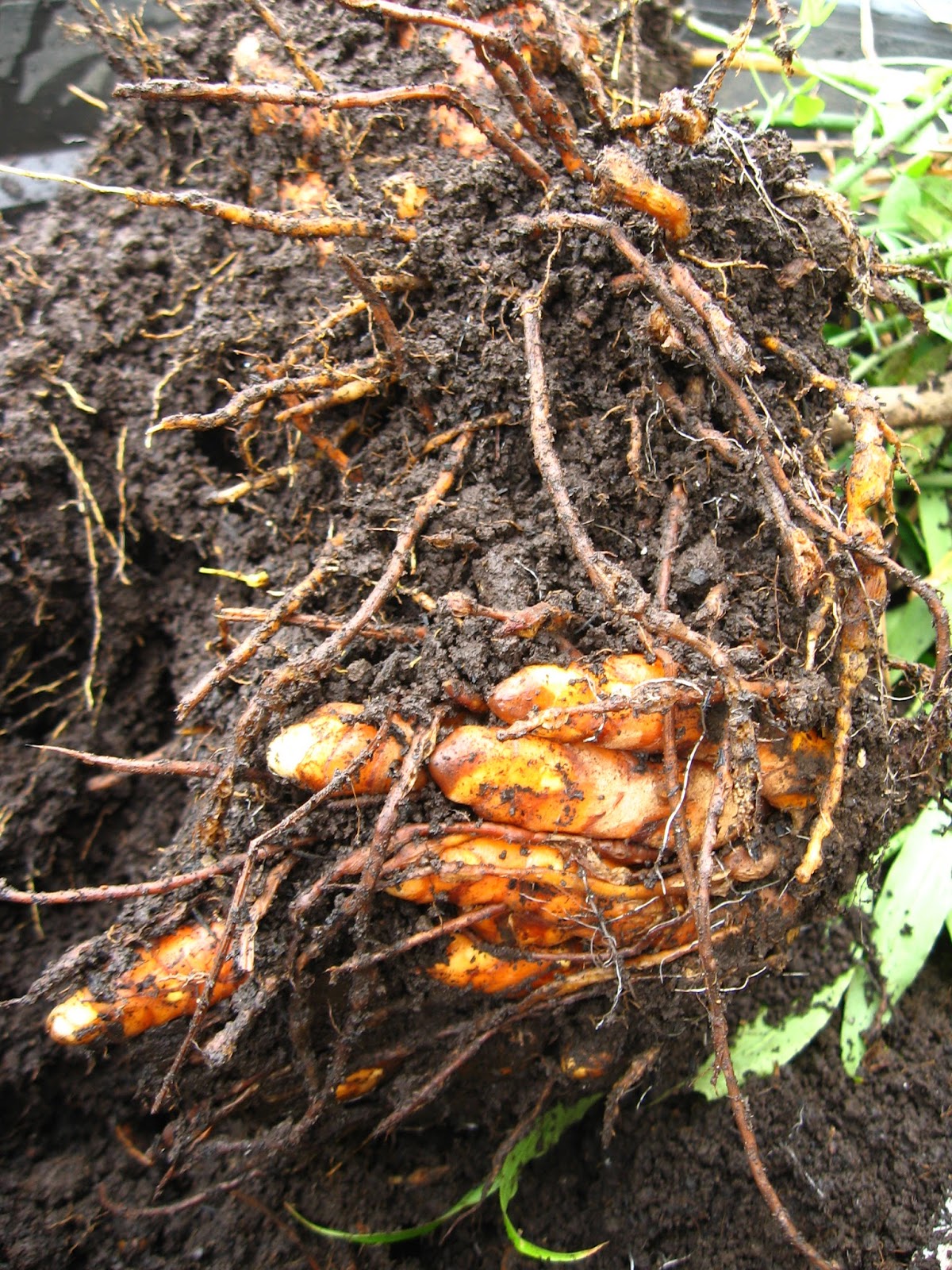
Turmeric and ginger are two common spices in Indonesian cuisine & kitchen and are among the easy-to-plant spices.Just bury them in the ground and oo la la... it's ready to be harvested in several months!


And yes, with only several turmeric and ginger root cuttings with nodes on them, you can harvest a bunch of them! I only planted 2 pieces of turmeric rhizomes and harvested 1,25 kg and with 1-2 cuttings of ginger root I harvested about 350 grams(under 5 months).


Since I used only a little of turmeric in my cooking (mostly curry), my helper made Indonesian herbal drinks made from turmeric, ginger, some tamarind, palm sugar and water.
It's good for boosting health. The Javanese have been having this for centuries. It's among many other herbal drinks passed down for many, many generations.

In two weeks time we have made about 3 batches of these drinks. Each batch is about 3-4 glasses.
And I still have some more turmeric for another batch I guess.

So, happy weekend y'all!


Tuesday, July 7, 2015

Harvest Nam Dok Mai Mango


Nothing can compare to a fully-ripened, organic-grown fruit! 

I am very satisfied with my Nam Dok Mai Mango tree! This is it's first debut and it has born 14 fruits! I have harvested 4 of them so far. And they are all satisfactorily sweet and juicy!


In my previous post on my Nam Dok Mai Mango Tree I said that my tree suffers from leaf gall midge disease, which was contracted while it was still in the nursery. Midges are very small flies in 1-2 mm in length. They lay eggs into the tissue of young leaves, leaving a small reddish spot which becomes swollen and soft, where the gall formation begins within 7 days and attains a diameter of 3-4 mm. Adults usually emerge from the underside of the leaf, leaving the pupal skin protruding from the emergence hole. The galls on the mango leaves will result in reduced photosynthesis, leading to leaf drop and lowered fruit production. Younger trees may die while older trees fail to recover normal growth after repeated attack. There are no examples of eradication of the insect anywhere in the world.


I experimented with my only organic way of eradicating this pest. It's only by poking the wart-like galls and then using a sharp object, usually my shears, I pierce through the spot, leaving a small hole.
My main purpose is to kill the insect in the pupal stage in order to prevent it from growing mature and infesting the whole tree. And so far I am successful! Of course this wouldn't be easy for mango trees grown in ground, as it can reach heights of 6 m or more but for container-grown trees this way is sufficient.


I don't encase the fruit with plastic bag this time, and so far my mango fruit are growing healthy and not attacked by fruit flies.


Monday, July 6, 2015

Harvesting Watermelon

When my watermelons were half-way growing, the trees were attacked by aphids. Soon, they were overcome by it and succumbed as you can see from below image. The leaves were dried up as the result and I had to salvage the fruits. I was hoping that they're mature enough to be picked.


When I was about to picked the watermelons, I stumbled upon this rotting fruit. The culprit must be the aphids since I saw some of them near the openings.


I was relieved to find 4 watermelons were still in good condition. They are not very big in size, only around half kg each.


 But I was very pleased to find that 3 of them were mature and sweet! I was a bit surprised that I had two varieties here, the yellow and orange flesh. I saved the seeds for future planting.


Friday, March 27, 2015

Updates of my Pineapple Tree

Add caption
Do you remember my fruiting pineapple tree? Here is some photos for an update.

It sends a sucker out from the base...


and about 7 ratoons just right at the base of the fruit.

 
This was my first time planting pineapple from the crown and it turned out a success. Anyway, it only took about a year for my pineapple tree to start flowering and about 3 months for the fruit to ripe. This is fast compared to the information I got that pineapple tree will start to flower at the age of 18-24 months if planted by the crown. I wonder if the homemade liquid enzyme has contributed to it. How about your experience planting pineapple? 


Look at the ratoons, at this size they are ready to be replanted!


Gardening is indeed very rewarding and satisfying despite all the troubles and works!

Monday, December 15, 2014

Planting and Harvesting Onion


 Sorry for not updating for sometime, I had some problems with my computer last week. My Windows7 wouldn't let me access my computer 'cause I canceled the file-compressing process half way. And I had to be without my computer for about a week. Thank God for a good church friend who happened to be a computer expert, who helped me with helpful advices on how to reboot my computer in an effort to save all my data.....and thank God it worked!!

By the way, I actually want to share about how easy it is to plant onion from onion especially in the tropical weather where Sunshine is abundant! There are three ways of planting onions and for more information on it you can click here

As for me, planting onion from the bulb is the easiest. I just burry onions I buy from the market, leave it and it will grow. I mix 1 part of soil with 1 part of cow/goat manure and a generous amount of organic matter, ie. mature compost . And I make sure to keep the soil moist not soggy, because soggy soil will cause the onion to rot(from past experience).


Below, you could see the onions I harvested today. One cluster of onions is bigger than the other. Just keep in mind, if you want to get bigger size of onions, then you have to choose 
the biggest bulb to plant! 
Still, both clusters are edible! :-)


So, when can we harvest the onions? This time I didn't keep a record of the germinating time 'cause in the first place I just wanted to get some spring onions from it, that I mostly needed for cooking. So, it wasn't planned! Therefore, I can't tell you exactly how long it took the onions to grow in order to produce mature onions. It's quite fast though if we plant it from the bulbs, I guess it's just about 3 months or so, however, I'm not really sure.  


But don't worry, there's one hint that can be an indication for us, that is the falling, wilting and drying of the leaves. Once the leaves fall by themselves, just let it wilted and dried. In my case, I left it for about a week to be thoroughly dried before I extracted it, cleaned it from dirt, and dried them under the sun for several hours, before I brought them inside to further hang them for another 2 weeks to be completely dry, so that it will be good for a long-term storing.

I just germinated more onions today, and this time I will keep a record and I will update more details later. Why not planting along with me? It's very easy, and self-planted-organic-onions will soon be available in your kitchen!

Sunday, November 9, 2014

My First Harvest of Eggplants


I am not good at keeping a garden tally. It might be because I'm still harvesting in smale scale or just too excited to go ahead and process it into meals. The fact is, I usually went up to my rooftop garden to harvest things I needed to cook at that moment. So, maybe that's the reason I didn't really remember to scale and keep the tally, except for taking some pictures of it. I might start doing it for the future, we'll see...


So, here's some eggplant which was processed into this yummy dish. Basically it's a mixed veggies dish (eggplant + baby corn), cooked in spicy fermented soya sauce.


Friday, April 4, 2014

Planting Cucumber


Cucumber is one of the vegetable plants that fascinated me much in the process of planting. My first cuke plant is Cucumber Marketer. It started to bloom about twenty male flowers for about a week or so before the female flowers came out.


At first it sets in only one female flower a day and after about a week, two or three.

First day of blooming - Female Flower
Both Male and Female flowers' prime is only a day. It means a day to produce pollen for the male flowers and a day up for a pollination for the female flowers. If we miss it, it will be too late as it withers and falls.


I had hand-pollinated at least 18 female cukes and at first it seemes that they're starting to swell up but then after a while I noticed that they stopped growing, especially after getting soaked from a downpour or suffered from a sun-scorching day. I then started to move them to a shade during the scorching noon and afternoon in order to protect the pollinated female flowers and the leaves from getting sunburnt.

One day as I was going to pollinate a female flower,  I found this one survived, but only this one which was growing... fast. In days it got this big.

So what happened with the others...?


The growth stalled and they're getting yellow―immaturely.


 And sadly I had to remove them...

 I harvested the cuke after it got about 13 cm long and about 6 cm wide.

It's stout and  fleshy with few seeds but the size and form was not like the one shown in the seeds catalog which is longer and not as stumpy as this was. The taste was a bit bland and not as sweet and crunchy as the local breed. I wonder if it's a little too ripe as I had already seen a little crack on the lower skin.

After several days after the harvest, I got some new blooms and had them pollinated but again only one got succeeded. I wonder why I can't have several cukes succeededly pollinated at the same time? Does the plant automatically abort other baby cukes because it has not enough energy for all of them since I plant it  in  a 4 gallons container? (shoulders shrugged and eyes rolled)


Related Posts Plugin for WordPress, Blogger...