Showing posts with label organic gardening. Show all posts

Monday, December 15, 2014

Planting and Harvesting Onion


 Sorry for not updating for sometime, I had some problems with my computer last week. My Windows7 wouldn't let me access my computer 'cause I canceled the file-compressing process half way. And I had to be without my computer for about a week. Thank God for a good church friend who happened to be a computer expert, who helped me with helpful advices on how to reboot my computer in an effort to save all my data.....and thank God it worked!!

By the way, I actually want to share about how easy it is to plant onion from onion especially in the tropical weather where Sunshine is abundant! There are three ways of planting onions and for more information on it you can click here

As for me, planting onion from the bulb is the easiest. I just burry onions I buy from the market, leave it and it will grow. I mix 1 part of soil with 1 part of cow/goat manure and a generous amount of organic matter, ie. mature compost . And I make sure to keep the soil moist not soggy, because soggy soil will cause the onion to rot(from past experience).


Below, you could see the onions I harvested today. One cluster of onions is bigger than the other. Just keep in mind, if you want to get bigger size of onions, then you have to choose 
the biggest bulb to plant! 
Still, both clusters are edible! :-)


So, when can we harvest the onions? This time I didn't keep a record of the germinating time 'cause in the first place I just wanted to get some spring onions from it, that I mostly needed for cooking. So, it wasn't planned! Therefore, I can't tell you exactly how long it took the onions to grow in order to produce mature onions. It's quite fast though if we plant it from the bulbs, I guess it's just about 3 months or so, however, I'm not really sure.  


But don't worry, there's one hint that can be an indication for us, that is the falling, wilting and drying of the leaves. Once the leaves fall by themselves, just let it wilted and dried. In my case, I left it for about a week to be thoroughly dried before I extracted it, cleaned it from dirt, and dried them under the sun for several hours, before I brought them inside to further hang them for another 2 weeks to be completely dry, so that it will be good for a long-term storing.

I just germinated more onions today, and this time I will keep a record and I will update more details later. Why not planting along with me? It's very easy, and self-planted-organic-onions will soon be available in your kitchen!

Sunday, November 30, 2014

Planting Pineapple from the Crown


Nothing is more happier than finding one of 3 pineapple crowns I planted in November last year, has finally started blooming!!! YAAAAY!!! Look at that cute pinkish bloom! 


How long does it take pineapple to bloom and set fruit if we plant it from the crown? The answer is between 16-24 months, depends on whether you plant it outdoor or indoor. If you plant it outdoor, normally it will start to bloom within a year
but in my case, only one from 3 crowns has started to bloom. 
I'm not sure why, but they are the same variety and planted on 
the same day.
 

I guess the size or depth of the containers used may play a role in  the health of the plants, as it provides more space for the roots to develop and thus influence the maturity of the plants. I use 
4-gallon pots for each of the two plants and one basin type bucket 
for the other one. 


I wonder if my hypothesis is right. 
Normally pineapple can bear fruit 3 times during their lifetime before we must replace the plant, but indoor potted plant are more likely to produce only one or two fruits during their lifetime because they may not always receive the optimum condition necessary for thorough fruiting.


The mother plant, or the first plant grown, produces a single fruit from the center of the crown. The second and third fruits grow from side shoots off the mother plant, called ratoons. In large containers we can leave these shoots, or suckers, on the mother to continue growing. The suckers are usually removed in smaller pots and transplanted to their own container, where they become a new mother plant. Each ratoon can only flower once, and it itsn't likely to send out its own suckers if left on the mother plant. Although each mother can produce multiple suckers, it's best to remove all but the two strongest. Too many suckers on one plant weakens it and minimizes the chance of fruiting.


Saturday, November 29, 2014

Contemplation


Gardening can be a very rewarding experience, especially in terms of relational: relational to God, to the nature and 
other human beings. 
It can improve our mood and pumping new energy for us. 
Gardening is potential to be a collective activity, 
a hobby, a keen interest you can infect others with. 
Many times I bring down my plants just to show to my mother,
for the purpose of simply sharing this journey together 
and to show her all the beauty and natural wonders of 
the Plant kingdom. 


Gardening can even bring healing to our soul and body 
and thus, no wonder some people incorporated gardening into the therapy medication. For those who have been gardening will understand the feeling of witnessing the first shoots and seedlings emerging from the soil, though it's just the cotyledon (false leaf), and experience the fullness of joy when the seeds turn into 
a sweet harvest.
Gardening is magical, enriching and worthwile!
Gardening is transforming! 
It transforms the way you perceive life. It transforms your patience. It transforms your endurance. It transforms your depencency on your own strenght 'cause in many occassions you just can't control anything, let alone everything.


Saturday, November 1, 2014

Kale


 This is called Kale, if I'm not mistaken this one is Blue Russian. There are many kinds of Kale but the common one we have in Indonesia is the Chinese Kale called "Kailan". This variety is more tender than the others and are best for salad and light cooking. Kale is an excellent producer in cooler seasons since high temperature will cause the leaves to wilt and sunscorched.


It is relatively easy to plant, and will keep growing leaves after each time of harvest.


Kaffir Lime


I bought this small Kaffir Lime plant from a nursery. It was grafted but a very tiny plant. I guess, I should have been focusing on strengthening the roots and plant for a couple of years before letting it to bloom and set fruit, but the cuteness of the blooms and small bumps of the fruit melted my heart and I gave in to it.  And here's the first fruit! :-)


Baby Cuke


Last spring, I planted this variety of cuke, it says baby cuke, but the size is smaller than my expectation. It's really cute though. I bet you'd agree with it.


Green Beans


If you pay attention, you will see two types of bean plants in the above picture. On the left I have borlotti beans and on the right green beans. Yet only the green beans producing. I've never succeeded with either Borlotti or Tongue of Fire beans so far.... I've been experimenting but it never has worked. I blamed it to soggy soil and the tropical heat.


Last planting season, I tried to plant green beans from the seeds I bought from a local seed seller. It grew lusciously green and produced a lot of blooms, but failed to fruit due to lack of pollen as the result of the heat. I was quite discouraged, thinking that I would never have luck in planting beans,
 but once the temperature gets colder and rainfall is high, it starts to fruit ‒ in abundance!  And it keeps blooming, fruiting, blooming, fruiting.... on and on.... I keep harvesting along the way. And believe it or not it's all but through 2 healthy plants in a 3 gallon pot. Bravo!


Loofah


Beautiful isn't it? This is my first loofah plant. I got the seeds from a friend who ran an organic gardening training center. At first I thought it was the common ridge gourd we have here. Honestly, I thought I got wrong seeds, when it set fruit, I once doubt if it was edible at all like the common gourd, but to my surprise it's delicious!

This I believe is self-fertile too though it also has male blooms. And though I also helped with hand pollination, but I believe it is not required since in some occasion it set fruit with less help from me.


I simply stir-fried it with some garlic and onion and on top of it I put some sliced scramble eggs. It' very tender and yummy!


Finally my FIRST Mangoes!!


 I bought my first mango tree from a local nursery last September 2013, it was less than 50 cm tall. It was a grafted tree of a local species called Harum Manis (literally translated into Sweet & Fragrant). I asked the guy at the nursery, how long would it take to start fruiting. And he answered about a year! I could hardly believe him, a dwarfie tree like this would fruit in a year? I just smiled and thanked him.


Later at home, I searched the internet, and to my surprised, the source said that at least it takes 3 years for a grafted mango tree to start setting flowers and fruit. To be honest, I was a little disappointed. Though I didn't buy what he said, but I somehow really wanted it to be true... :-D


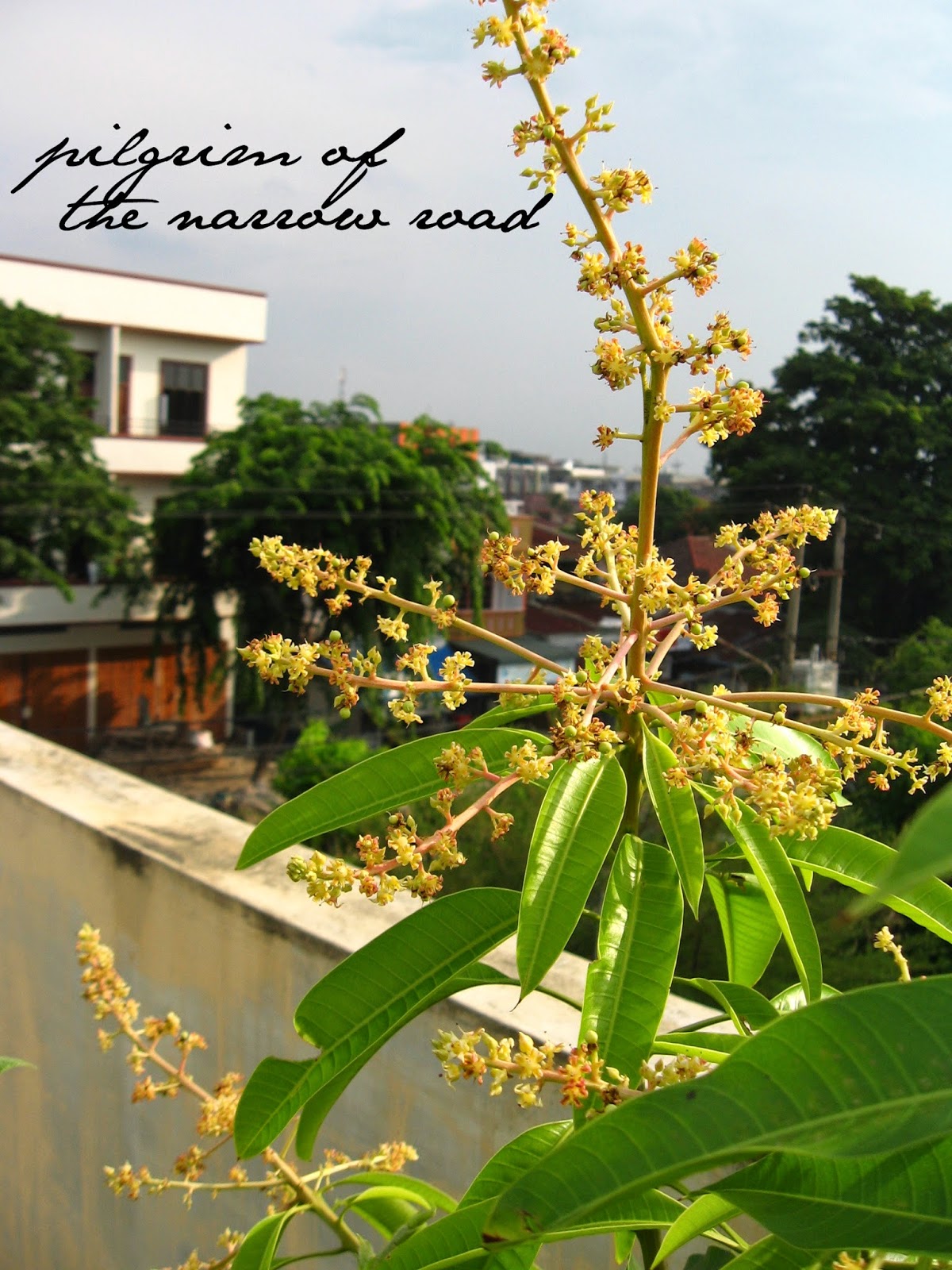
My mango tree continued to grow and got taller. So one day in spring, when my mango tree started to grow unsual shoots, I was very intrigued. I wait and voila! It set flowers!! Just in about 7or 8 months! My jaw dropped! The guy was RIGHT!! Yippie!!


Since mango doesn't need a hand pollination, I let the nature do it's job. The wind, the insects, everyone was busy doing the task for me! It sets hundreds of small flowers and many I believe got pollinated, but in the end the nature will also screen those which are not well-pollinated. They will eventually dropped from the trunk.

The monsoon period in the Summer brought a lot of rain and high speed wind. That caused many of my baby mangoes to drop since the pot sat in the way of the wind. That's a very hard lesson to learn. Any fruit trees shouldn't be exposed to a lot of wind (especially strong one). It will cause a lot of stress for them and will cause the fruit to be aborted by accident. So, I move it instantly to a spot where it is more protected from strong wind.


Only 5 mangoes survived this season, but it was already amazing given the size of the pot which is only size 5.


Related Posts Plugin for WordPress, Blogger...