Tuesday, November 5, 2013

Asian Savory Spaghetti

Asian Savory Spaghetti served in one of my favorite childhood vintage enameled tin plates
Cooking is an 'adventure' for me where I can explore as far as I like to. There's a zillion of recipes to experiment with and so many ingredients and spices to explore. In the end you can always come up  to something that fits your standard and appetite. Your own recipe!

However, I have a big issue. I hate to spend tons of money shopping ingredients just to learn or cook one new recipe and not sure of when I will be using the leftover ingredients! Instead, I like to invent my own recipes with ingredients I have in my fridge! I'm sure some of you can identify with it! :-)

So this morning, again, I am making breakfast for my family. And today I'm going to make an 'East meets with the West' kind of recipe, of course with all the dry and fresh ingredients I have at home and in the fridge! Yay!!

It's a fried spaghetti and I call it "Asian Savory Spaghetti" because I'm using a couple of ingredients that are specifically from Asia and mostly used by the Chinese and Indians: Cumin powder and Bakwa (Chinese Sweet and Salty Pork Jerky). I am glad with the fact that I still have some more Bakwa in my freezer. It's just as good for fried rice and fried noodles as it is slightly fried with a little oil and served with steamed rice! So, let's start cooking!


Ingredients:
1 cup of Sugar Peas Pod, whole
1 cup of red/purple cabbage, shredded
2 cups of mixed-color Paprika/Bell Pepper (green, yellow, orange and red), chopped
1 medium onion, chopped
2-3 cloves of garlic, minced
10 hot red pepper
6 small spring onion
1-2 pieces of Bakwa, cubed
500 mg of Spaghetti
1/2 cup of vegetable oil or olive oil
11/2 Tbs of Cumin Powder
Salt
Water

How to:
1. Boil the spaghetti until all dente, set asside and continue to heat the oil in the skillet. Sauté garlic until brown and fragrant. Stir ini onion.


2. Then, add the hot pepper, Bakwa and Cumin Powder. Stir until the meat is slightly crisp and fragrant.


3). Put the cabbage and bell pepper.


4) Stir until slightly cooked.


5) Because sugar peas pod only takes a while to cook and best when it's still crunchy, make sure you add it after the other veggies are tender.


6) Add in the spaghetti and a little water to help making all the ingredients blended.
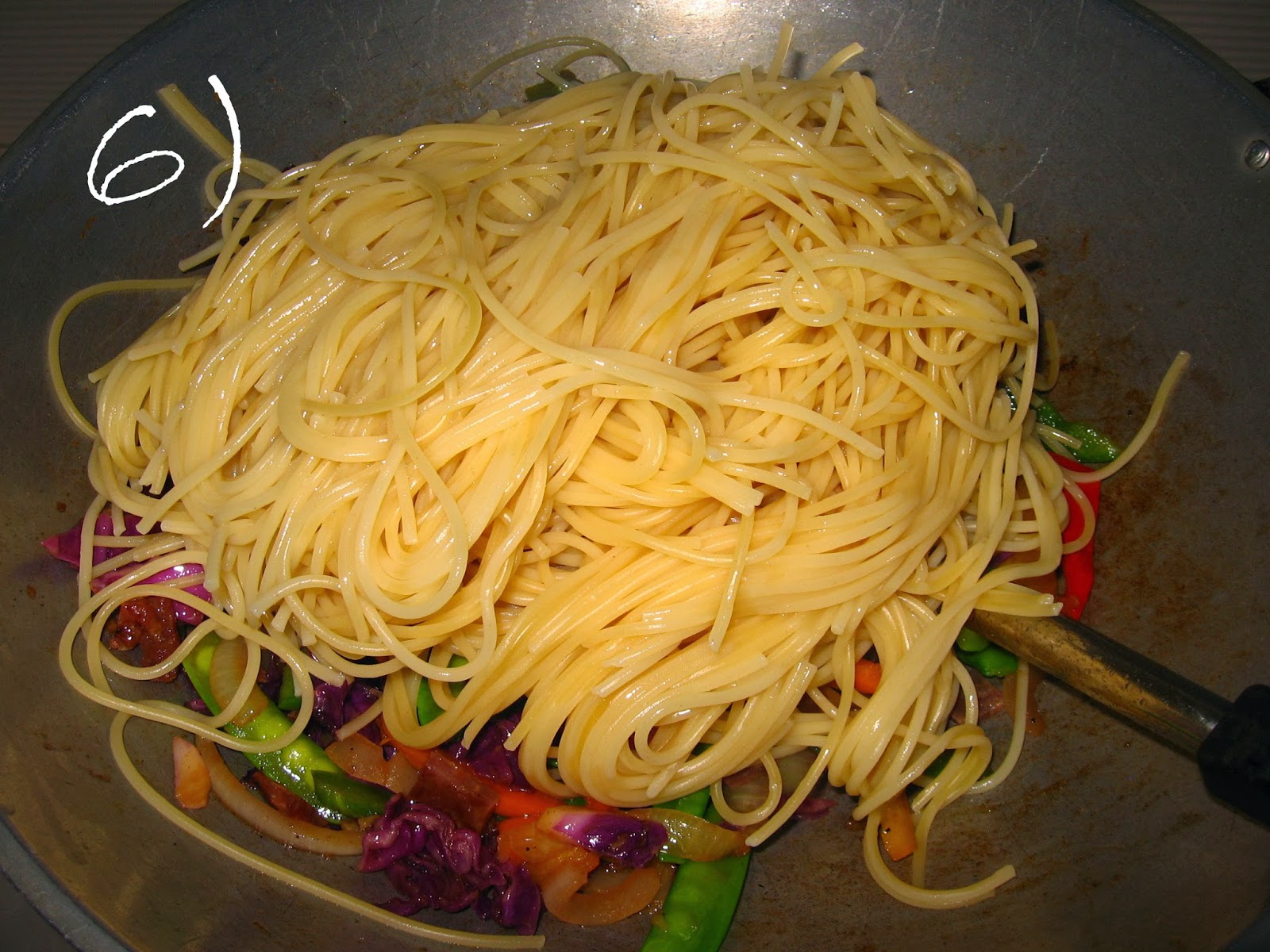
7) Sprinkle salt, adjust it to your own taste but make sure it's not over, so it won't overwhelm the taste of other ingredients. Stir until all ingredients are well blend.

8) Done!


Monday, November 4, 2013

New Additionals in My Rooftop Patio Garden

My rooftop patio garden got some additionals. I bought them from a vendor last saturday at the market. As you can see, they enliven my garden! And the other day I noticed that they have started to attract some insects.


Ginger Sugar Powder


Indonesia is famous for its spice-laden food. We use many kinds of spices, including hot peppers and those of ginger family. The Chinese also like to use ginger to add flavor to some of its cuisine, such as steamed fish, steamed/stirfried/Braised chicken, rice congee, and many more. It is also used to eliminate fishy smell of seafood especially in soups.

The Javanese also like to mix ginger and other spices into herb potion called "jamu". Beside its warming property, it is also believed to improve health if consumed on regular basis. 

I myself, love to use ginger when cooking Chinese and Indonesian food, such as : steamed fish, rice vermicelli soup, and rendang (spiced chicken/beef). 

I love ginger drink too. At rainy season like this, a glass of hot ginger drink will be superb! It's been my favorite drink during cool rainy season.

When I was still working at a community development foundation, I once visited a training center for agricultural and liverstock farming. There, I had an opportunity to see them training the women how to make Sugar Ginger powder for home industry. About several years ago I tried to practice it at home, but because I used too much liquid (water) it was failed and turned into ginger caramelized candy instead! 

Not giving up, this time I give it a try again and here is the result! Check it out! 

1). First of all, there are two types of ginger root. The red and white ginger. The red one is more spicy, while the white ginger is mild.Thus, if you can't tolerate too spicy then the white ginger is perfect for you. So first, have them washed and brushed before being processed.

2. Skinned and washed once more. The ratio is 1:2 (if you are using 1 kg of ginger then you must use 2 kgs of sugar (either white or brown) but if you like it more spicy, than you can use 1:1 ratio.

3. Grate all the ginger (this will take time and also excruciating burning sensation on your hands if you don't protect them with gloves. Halfway I gave up and decided to use the blender, but my blender needs some water in order to process the ginger and I ended up using more than 2 cups of water as you could see in this picture. My suggestion is best to hand grate so we could control the amount of water (± 1 cup) or you could use the food processor. I was quite nervous  that the juice turned this much, I was afraid it would turn into caramelized candy again... So, my suggestion is: Watch the amount of water. 

4. The next step :  Run it through a sieve and pour all the ginger juice into the skillet. You may use a non-stick skillet.

5. Add 2 kgs of granulated sugar. Turn on the gas stove and start to stir. Remember that we must continue to stir until it's done. Don't leave it unattended as it can brim over and spill when it is boiled, and if you don't keep stirring it, it may singed at the bottom.

6) Starting to boil. Keep stirring. 

7) The Sugar starts to change form into a thicker caramelized sugar. From this point on, turn the stove to low heat and simmer. Keep stirring.

8) After around 1 hour, the caramelized sugar turns thicker like this. You can see that it's starting to change form into sandy caramelized. Increase the speed of stirring.

9). The caramelized sugar turn into this in around 75 minutes of cooking and stirring.

10) Finally, it's getting dried up and become sandy powder like this. Make sure that you reduce the heat more into a very low one. Keep stirring vigorously and try to break as many sugar lumps as you can into sugar powder using the wooden spoon. Make sure that the sugar powder gets dried.

11) Now it's done! The next step is to cool it down. If you want a finer powder, you could use the food processor to mill it into fine powder after it's cooled. 

12) Then, you can store it in jars or you can packed it in plastic bags and seal it. This sugar ginger powder can be stored in jars at room temperature for more than a year. If you store in the fridge it can be stored for more than 2 years.

Now, you can always have a cup of hot ginger drink anytime you want! Just mix a couple spoonful of sugar ginger powder with a glass of hot water and here you go! If you try this at home, do let me know how's your result turn out.

Friday, November 1, 2013

Watermelon Radish Stirfry

I found some watermelon radish at the supermarket and I couldn't wait to try it at home. It's the first time I saw it here, I think it's locally grown now. The inside is beautifully pink with sweet taste and crisp texture. It's also quite juicy. No wonder they called it watermelon! 

I am trying to propagate it using the top cut by leaving about 1 cm of the meat and leaves. (Will update how it goes)


Recipe :
1 whole big-size watermelon radish, skinned and julienned
2 cloves of garlic, minced
250 gram chicken breast, diced
a handful of cilantro, coarsely minced
Vegetable oil for stirfrying 
3-4 cups of water
salt

How to:
1) Sauté garlic til fragrant. stir in chicken breast, stir. 
2) Add radish, finely stir until fragrant.
3) Add water. 
4) Cooked until it's tender.
5) Throw in cilantro and salt. Serve.


Thursday, October 31, 2013

Rainbow Fried Rice


One of my morning routine is to prepare breakfast for my mom and myself. Just like usual, I like to cook from what I have in my fridge. So, this morning I made fried rice because I have some left-over steamed rice in the fridge plus other ingredients I just bought the other day. So here it is the Rainbow Fried Rice!


 And here is the ingredients:
- 2 cloves of garlic, minced
- 2 cloves of onion, sliced
- a handful of sugar pod peas, halved
- a handful of Iceberg lettuce, chopped
- a handful of cilantro leaves, coarsely minced
- Some bell-pepper, chopped (mix color of green, yellow, orange and red)
- 5 hot chilli pepper, diced (optional)
- 2 eggs
- a piece of Bakwa (Chinese sweet & salty pork jerky), diced 
- 3 plates of steamed rice (it's best if refrigerated overnight)
3-4 Tbs salted soya sauce
- 2-3 Tbs sweet soya sauce 
- salt
- 3 Tbs vegetable oil


Local Indonesian Salty and Sweet Soya Sauce
How to :

1) Heat the oil in the skillet and sauté the garlic until fragrant, stir in the onion and chilli pepper, stir until brown and to be followed by the eggs.


2) Then, stir in the Bakwa (pork jerky), add about 2 Tbs of salty soya sauce, stir until it's fragrant and the eggs cooked. (I happened to have some Bakwa left in my freezer, my sister bought them from Singapore about 3 weeks ago. I like it because the flavor and the sweet taste of it enrich the taste and flavor of the fried rice, but certainly you can substitute it with other meats, sausages or even shrimps.)

3) Add Bell Pepper, stir until it's cooked.


4) I also added some leftover fresh-Iceberg lettuce from the other day. Stir well.


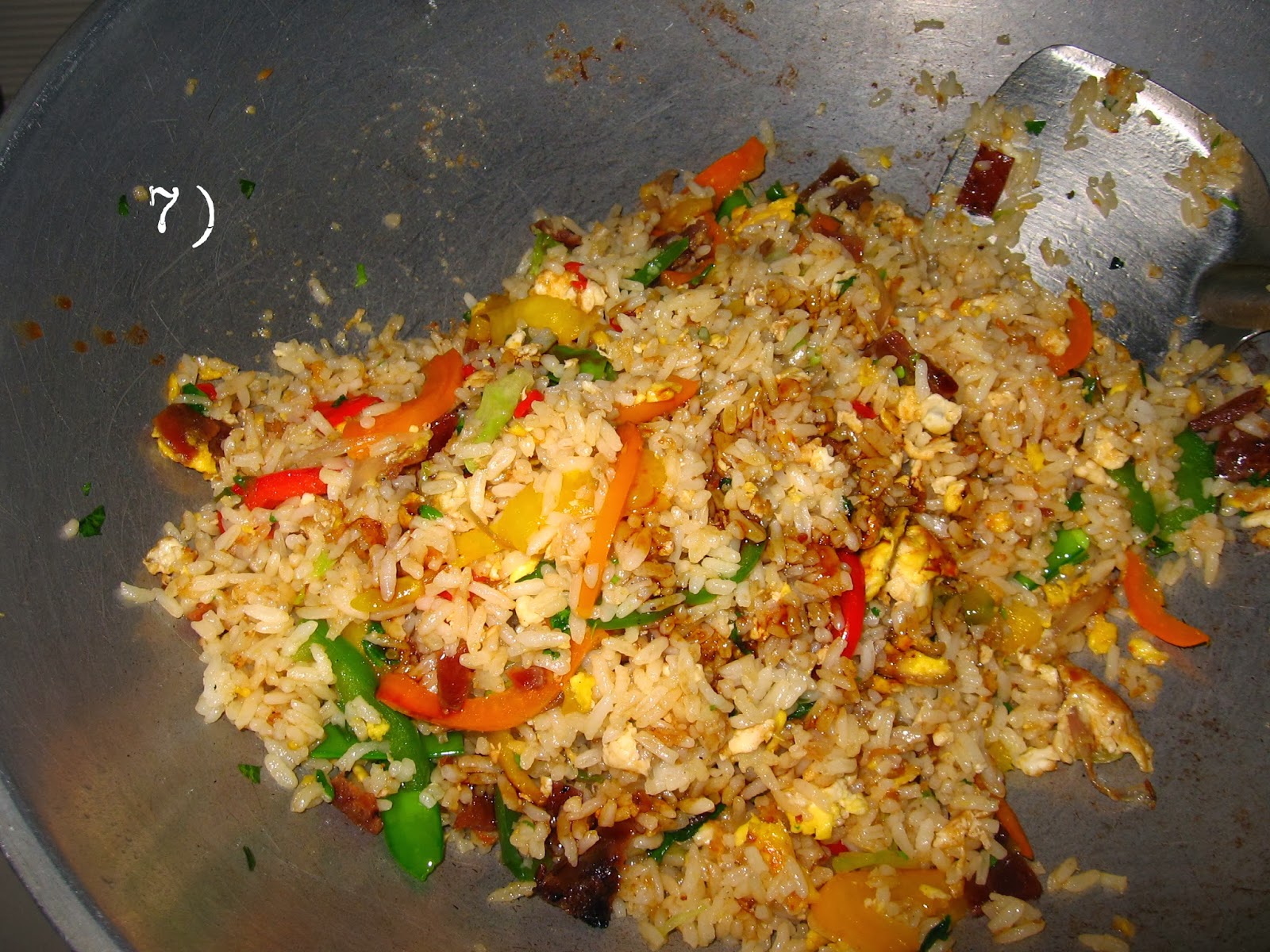
5) Now, you can add the rice in. Using a stainless frying spoon, try to break all the lumps of  rice by pressing the spoon onto the rice until it blends with all the ingredients. 


6) Stir in cilantro leaves and add more salted soya sauce and salt.


7) Last but not the least, add the sweet soya sauce, stir well for another minute. And there you go, the Rainbow Fried Rice is ready to be served! Put some cilantro leaves as garnish.


Related Posts Plugin for WordPress, Blogger...